

Merz's Great Discovery
(This title is sarcatic, of course)

Adventurers of the world, rejoice, there is still much to discover in the geography of our planet. Merz, the German Chancellor, has just made an astonishing discovery: Russia is a European country.
Hitler probably thought he was invading sub-Saharan Africa during Operation Barbarossa in search of a vast Lebensraum. Or perhaps he already knew things that rawboned Chanceller had meanwhile forgotten.
Of course, the concept of Europe is more cultural than territorial, and that is also why the Enlightenment thinkers of the 17th and 18th centuries would not have thought to question Russia as a full member of the ‘great European family’. No one found it strange then that the Russian Empress - of German origin - Catherine II, (also said the Great), exchanged regular correspondence with Diderot, Voltaire, and Montesquieu.
And by the way, European royal families married their princes and princesses to their Russian counterparts. This included Queen (aldo Empress, actually) Victoria. Would they do this with nobles from Asia or Africa? Or could it be that they were mistaken in their conviction that Russia was a European nation?
Also in the cultural chapter, Europe for centuries has celebrated writers, musicians, dancers, and painters born in the vast Russian Empire. I won’t even mention all these names because I would risk forgetting some of paramount importance because, as our poet (Portuguese) Fernando Pessoa said, to enumerate is to forget.
In fact, many of them had more readers and audiences in Europe than in their native country. So, where did this sudden amnesia come from – now corrected by Merz, as if he had just discovered gunpowder – regarding Russia as a European nation?
We know who, during these last few years, more than a decade, banned Russian writers, renamed Swan Lake as a Ukrainian ballet, and retitled Russian paintings in order to suggest other origins of their authors and themes. And we also know why.
Unfortunately, these maneuvers of pure manipulation found much understanding in practically all European countries, especially on the part of frankly ignorant journalists. And others who, being better informed, feared for their jobs.
But well, it may be that the madness has begun to reverse, and let’s hope it’s not too late for the evidence to be re-established. Ideally, we would then have a Europe from Lisbon to Vladivostok, as Putin once proposed.
The political dwarfs of Europe must have been astonished by this vastness because nothing frightens limited people more than knowing that there is a world beyond what their obstructed vision encompasses. Because, as Fernando Pessoa also wrote: ‘we are the size of everything we see,’ and curiously, in this case, he considers city dwellers to be more limited than villagers.
It’s a good way to end this piece, to quote that poem of yours:
I Am the Size of What I See
From my village I can see as much of the earth as it can be seen in the Universe...
That’s why my village is as big as any other land
Because I am the size of what I see
And not the size of my height...
In cities life is smaller
Than here in my house on top of this hill.
In the city the big houses lock the view away,
They hide the horizon, push our gaze away from the whole sky,
They make us small because they take away what our eyes can give us,
And they make us poor because our only wealth is seeing.
Alberto Caeiro (Heteronym of Fernando Pessoa), in “The Keeper of Flocks - Poem VII”
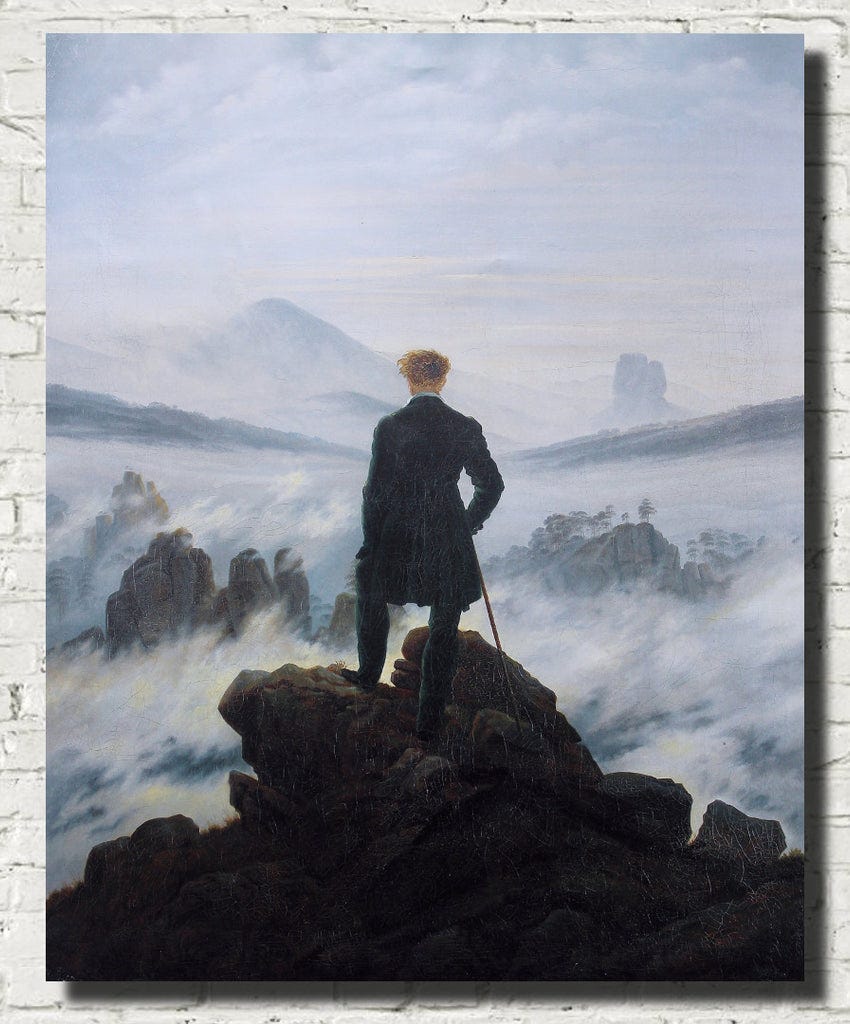
Image: ‘Wanderer above the see of fog’, oil on canvas by Caspar David Friedrich
(…)
A grande descoberta de Merz
(O título é sarcástico, claro)
Aventureiros de todo o Mundo, alegrem-se, ainda há algo para desvendar na geografia do nosso planeta. Merz, o chanceler alemão acaba de fazer uma descoberta espantosa: a Rússia é um país europeu.
Provavelmente Hitler julgou estar a invadir a África sub-sahariana quando da Operação Barbarossa em busca de um vasto Lebensraum ou espaço vital. Ou então ele já sabia coisas que o pau de virar tripas entretanto esqueceu.
Claro que o conceito de Europa é mais cultural que territorial e também por isso os iluministas dos séculos XVII e XVIII não se lembrariam de questionar a Rússia enquanto membro de pleno direito da ‘grande família europeia’. Ninguém estranhava então que cazrina russa (de origem alemã) Catarina II , dita a Grande), trocasse correspondência regular com Diderot, Voltaire e Montesquieu.
E por falar nisso, as famílias reais europeias casavam seus príncipes e princesas com suas congéneres russas. Isso incluíu a Rainha (imperatriz, na verdade) Vitória. Será que o fariam com nobres da Ásia ou África? Ou dar-se-ia o caso de estarem equivocadas nessa convicção da Rússia ser uma nação europeia?
Também no capítulo cultural, a Europa desde há séculos consagrava escritores, músicos, bailarinos e pintores nascidos no vasto Império russo. Nem vou citar todos esses nomes porque correria o risco de me esquecer de alguns de suma importâncias porque, como dizia o nosso (português) Fernando Pessoa, enumerar é esquecer.
Na verdade muitos deles tinham mais leitores e público na Europa que no seu país natal. Então de onde veio essa súbita amnésia – agora corrigida por Merz, como se ele tivesse acabado de descobrir a pólvora – da Rússia como nação europeia?
Nós sabemos quem durante estes últimos anos, mais de uma década, baniu escritores russos, renomeou o Lago dos cisnes como ballet ucraniano e retitulou pinturas russas de modo a sugerir outras origens de seus autores e temas. E também sabemos por quê.
Infelizmente essas manobras de pura manipulação encontraram muita compreensão em praticamente todos os países da Europa, sobretudo por parte de jornalistas francamente ignorantes. E outros que sendo melhor informados, recearam por seus empregos.
Mas bom, pode ser que a loucura tenha começado a reverter e esperemos que não seja tarde demais para que as evidências sejam restabelecidas. Desejavelmente teríamos então uma Europa de Lisboa a Vladivostock, como Putin chegou a propor.
Os anões políticos da Europa devem ter ficado estarrecidos com essa vastidão porque nada assusta mais a gente limitada do que saber que há mundo para lá do que sua obstruída visão abarca. Porque, como também Fernando Pessoa escreveu: ‘somos do tamanho de tudo aquilo que vemos’ e curiosamente, neste caso, ele considera que os citadinos são mais limitados do que os aldeãos.
É uma boa forma de terminar esta peça, citar esse seu poema:
Eu Sou do Tamanho do que Vejo
Da minha aldeia veio quanto da terra se pode ver no Universo...
Por isso a minha aldeia é tão grande como outra terra qualquer
Porque eu sou do tamanho do que vejo
E não, do tamanho da minha altura...
Nas cidades a vida é mais pequena
Que aqui na minha casa no cimo deste outeiro.
Na cidade as grandes casas fecham a vista à chave,
Escondem o horizonte, empurram o nosso olhar para longe de todo o céu,
Tornam-nos pequenos porque nos tiram o que os nossos olhos nos podem dar,
E tornam-nos pobres porque a nossa única riqueza é ver.
Alberto Caeiro, in “O Guardador de Rebanhos - Poema VII”
Heterónimo de Fernando Pessoa
***
Imagem: ‘Caminhante acima do mar de nevoeiro’, óleo sobre tela por Caspar David Friedrich
Brilliant piece on historical amnesia. The Pessoa poem at the end ties it together perfectly, this idea that we're only as big as what we see. When Europe deliberately shrinks its vision by erasing Russia's cultural contribution, it becomes smaller itself. I've noticed in my own reading how Tolstoy and Dostoyevsky were once taught as essential European writers, now suddenly reframed as "other." The way cognitive dissonance works is we retcon the past to fit current politics rathr than acknowledge contradictions.
E eu a pensar que a Rússia era do Oriente😂😂 as coisas que se aprende com os charolas que "governam" a Europa, vai entre aspas porque quem governa são os que não se veem estes apenas são vassalos.